
Sources for Union County Previous Owners
A backward ownership study in Union County draws on both current and historic systems. Begin with the newest dependable reference. Move older only once the parcel identity is settled.
| Source | Known span or status | Where used | Best evidence |
|---|---|---|---|
| DuProcess land index | Online start year not published | Web and Chancery Clerk | Grantor, grantee, type, date, recording reference |
| Courthouse index and deed books | Official physical route | 109 E Main St, New Albany | Earlier index and instrument images |
| MDAH Series 2050 | Union County Records, 1872-1952 | Reading Room and Media Room | Originals and courthouse microfilm |
| MDAH Series 1202 | Union entries begin with 1873 land material | Digital Archives | State Auditor county-record imagery |
Every source below offers dated links rather than a finished list of previous owners. Your job is to match each deed, plat, or tax roll entry to one identifiable tract before counting anyone as owner of record.
Walk Union County Ownership Records Backward
Run DuProcess in the direction your chain needs. Set the search to "To" for the recipient and "From" for the transferor. Check the land details, not just the surname, before you accept a match as part of the ownership chain.
- Find the current parcel and save PPIN, parcel number, legal lines, and deed reference.
- Open the newest deed and read its grantor, grantee, date, type, and description.
- Search that grantor under “To” in an earlier date span.
- Repeat while checking book/page, subdivision, lot, or section-township-range.
- Carry the last sound clue to courthouse books or MDAH when the web trail stops.
- Grantor
- The party transferring an interest.
- Grantee
- The party receiving an interest.
- Chain of title
- The linked series of instruments for the land.
- Legal description
- The land wording that can outlast a street address.
The Union County recorder search screen displays direction, date, book and page, legal description, address, parcel number, and PPIN controls on one form. Those fields give the anchors a backward deed search depends on.
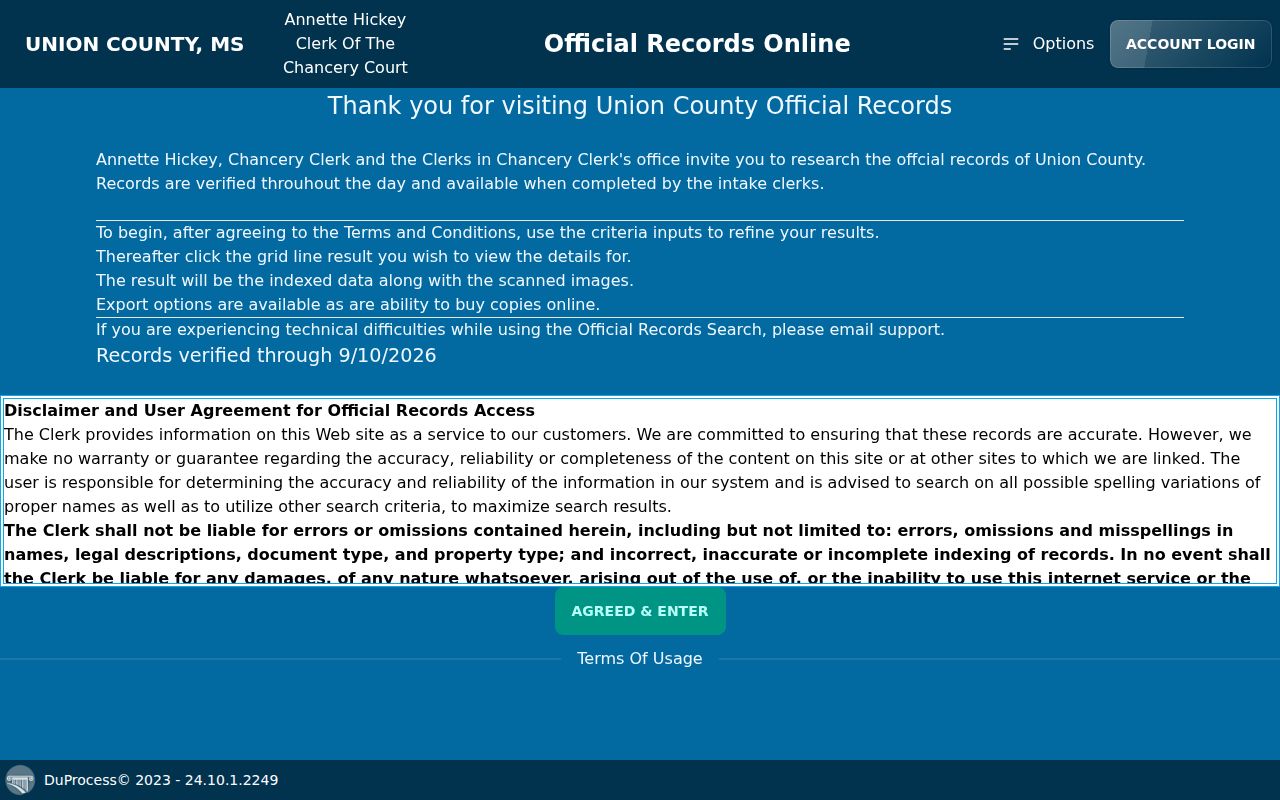
These controls let a previous-owner search continue through a name change or obsolete address.
Book References Are Union County Chain Leads
The assessor card for PPIN 013020 shows parcel 040N-08-002.00, alternate number 040N08 00200, a partial southeast-quarter legal line, and two references: Book 184 Page 574 from 1990, plus Book 10 Page 89, type WB, from 1989. Treat those numbers as leads. They are not a complete history of the tract.
Open each deed record itself. Read the parties. Compare the land each instrument describes. One reference on the card carries a zeroed date, which is exactly why an assessor summary can never stand in for the recorded instrument. The listed years do not prove the online index's earliest coverage either.
Note: An assessor book and page starts a former-owner search but cannot finish the ownership chain.
Bridge Union County Estates, Trusts and Name Changes
Earlier owners did not always hold land under one simple name. Some held as joint tenants. Some held through a trust, some through an estate. Some held under a different surname entirely. Search the decedent, the executor or administrator, the heirs, the trust, and any purchaser. An estate case file may spell a name differently than the land index does.
Copy the vesting and survivorship language verbatim. Note the trustee's authority, the probate order, and any later conveyance that followed it. A death record can support identity and timing for an eligible requester. But the property evidence lives in the deed, the recorded order, or the trust instrument. For an estate sale, keep the court authority, the confirmation, and the deed together as one package.
Check the court docket and the land index in parallel whenever an inheritance or ordered sale touched the tract. A final probate order, commissioner deed, deed of distribution, or executor deed may carry the change. The assessor's owner-of-record field cannot separate these paths. The estate representative may be indexed in place of the decedent himself.
Use Union County Plats When Lots Changed
A split or a merge can break a clean parcel sequence. So can an amended plat, a vacation, or a dedication. Search by subdivision, block, lot, section, township, range, and quarter. Then lay the recorded plat beside each deed description and compare.
Colonial Gardens shows up in Union County's index under its base name. It also appears under Sections A through D. Keep the exact indexed label. Phase-specific queries can surface different plats. A GIS map helps you find the ground, but it cannot replace the recorded plat. Treat acreage as a clue only. Assessor, GIS, and deed figures often differ through rounding, recording date, or residual tracts.
Continue Union County Former Owners at MDAH
The MDAH Union County finding aid covers records from 1872 through 1952. Request originals in the Archival Reading Room. Courthouse microfilm is self-serve in the Media Room. A finding aid maps the collection; it does not promise an online deed image.
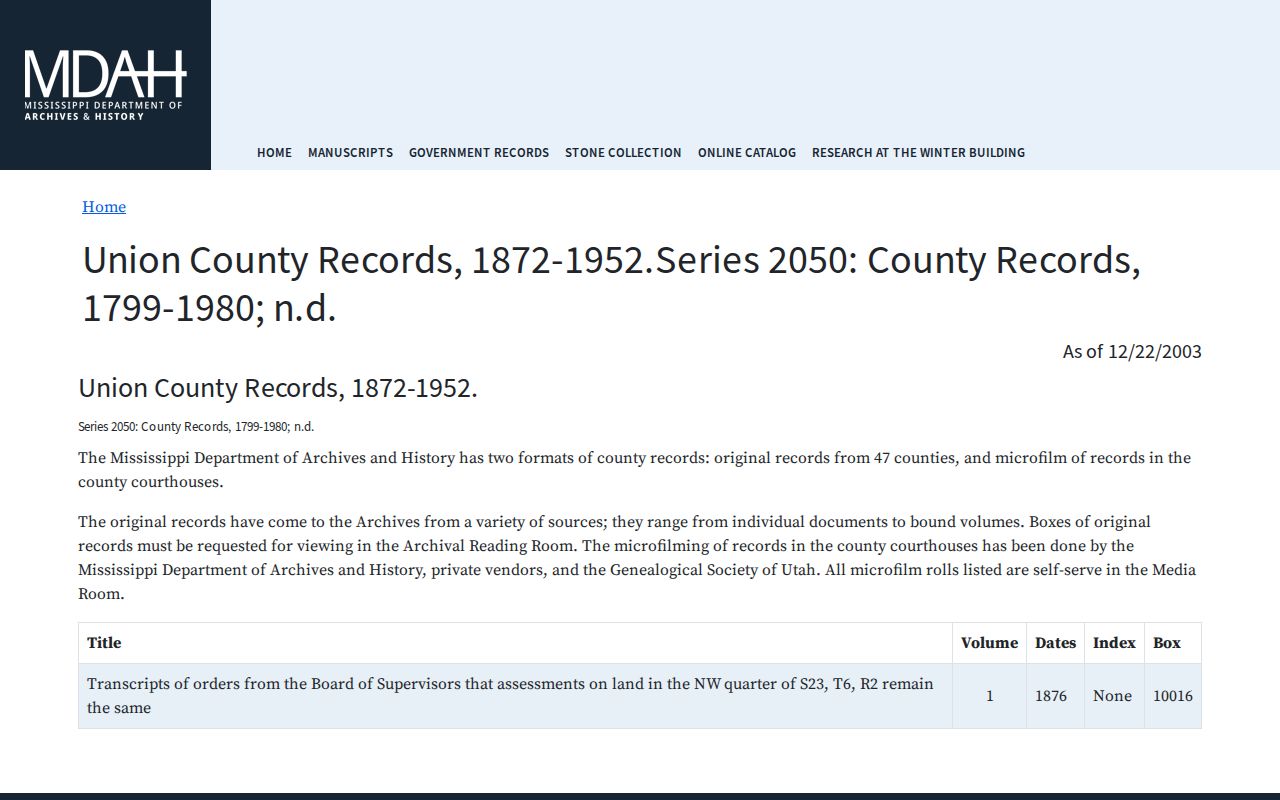
Use that distinction when planning a visit: original-series requests and courthouse microfilm searches run through separate rooms and separate requests. The Union Digital Archives listing adds 1873 land material along with later personal-record years worth checking.
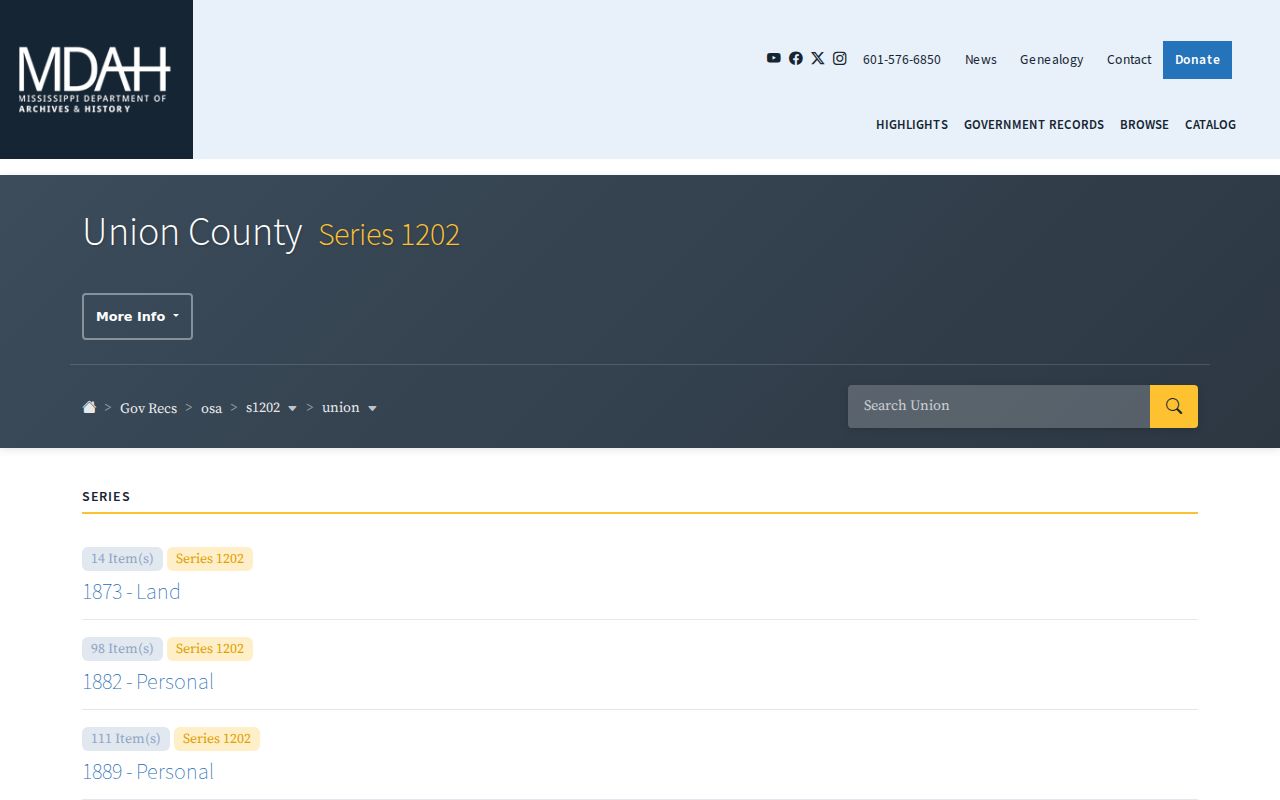
These entries are State Auditor records, not a full run of Union County deed records. Reconnect every useful item to the land index before treating it as part of the chain.
Separate Historic Union County Context From Proof
The Library of Congress holds an eight-sheet Sanborn set for New Albany, dated December 1913. It reveals blocks, buildings, mills, rail lines, and street context. Fire-insurance footprints, though, are not parcel boundaries. The Union County Heritage Museum keeps bound New Albany Gazette volumes from 1937 through 1980. These are a strong source for subdivision and courthouse-sale leads.
Confirm every newspaper mention or map event against a recorded instrument. Union County has no verified courthouse-fire or deed-book-loss history. So do not plug that story into a chain gap. Work from the clerk's index, Original Entries-Patents, the Sectional Index, and the archive's stated holdings instead.
Test Every Union County Prior-Owner Link
A strong match rests on more than a shared surname. Compare lot and quarter wording exactly. Check parcel references, adjoining tracts, reservations, easements, and date sequence. Where a parcel was divided, log the parent tract and each child lot separately.
Log the query, spelling, filters, result count, image status, and source date for every search. A blank result means little without those settings. Plats and road dedications can create a new address without any transfer of ownership. The Union County deed records page handles a single instrument and copy channels. This page follows the chain across time.
Pull related filing categories when a transfer looks incomplete. A release, partial release, substitution of trustee, correction, affidavit, judgment, lis pendens, or tax-sale instrument can explain a later event. It is not the conveyance itself. Read the image and note its parties and land description. A deed of trust only secures a debt. A later one never proves an earlier obligation was released. Keep the uncertainty in the chain until the matching release, order, or corrective filing appears.
How Far Union County Ownership Evidence Reaches
The online cutoff was not found in official sources. Work back through the courthouse's official index and books, MDAH originals, microfilm, the catalog, and selected digital images rather than treating a web miss as the oldest owner. A narrow Mississippi Public Records Act request can name the property, record type, date range, and format, though an office need not create a new title analysis.
The specific 1876 MDAH volume of assessment-order transcripts for northwest-quarter land in Section 23, Township 6, Range 2, Box 10016, has no index. It shows why section and quarter terms can beat a surname for old land. Preserve that type of location clue at every handoff.
The county's index categories include Original Entries-Patents, General Index-Deeds, General Index-Deeds of Trust, substitutions, Sectional Index, Map/Plat Book, lis pendens, construction liens, federal tax liens, and federal civil judgments. Search the category that matches the historical question instead of assuming every prior owner appears under a modern deed filter. Patents and original entries can sit apart from later conveyances, while a recorded judgment or probate order may explain an ownership change that has no ordinary sale deed.
When contacting the clerk, identify whether inspection, an ordinary image, a certified copy, or a physical-book check is needed. Provide the last known owner, approximate dates, legal description, book/page, and section-township-range. If the office refers the request elsewhere, save the receiving office and date. A referral can explain a records gap and beats collapsing every unsuccessful step into "not found."
Coverage boundary. Union County's web start year is unverified. Older former owners require courthouse or archival research, and all living-person information must be used lawfully without harassment.